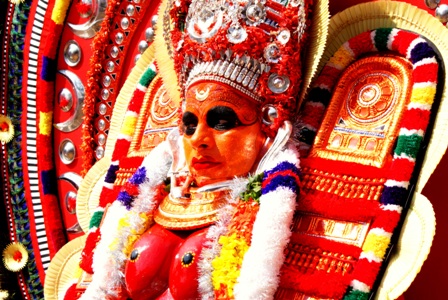
 About Theyyam Theyyam is an artistic dance form where metaphysical thoughts and expressions of immortal souls are impersonated to a believer through a mortal body. Theyyam originated from "Kaliyattam" once practiced by the tribal community of north Kerala. Theyyam had grown to the present form through many transformations since it’s origin. Landlords and chieftains of those days are the main forces behind many of such transformations. The community and its body began to use this art to propagate the major theme of social enforcement. The artists are also encouraged by the authorities to introduce new themes into its traditional layers and classified different acts and expressions to match specific needs for their desire. The character representations were very broad. They range from mild to wild in representations. Theyyam is a sect in which old heroes are sanctified and worshipped as the guardians of villages and homes. Yet, it includes a complex universe centered on the belief that a man can—after suitable mental, physical and spiritual preliminaries—don the costume of a particular deity and then become that deity. In this elevated state he assumes superhuman and divine powers—speaking, moving, blessing and even healing as a god or goddess. What is crucial is that the person is not possessed by the spirit of the deity. |
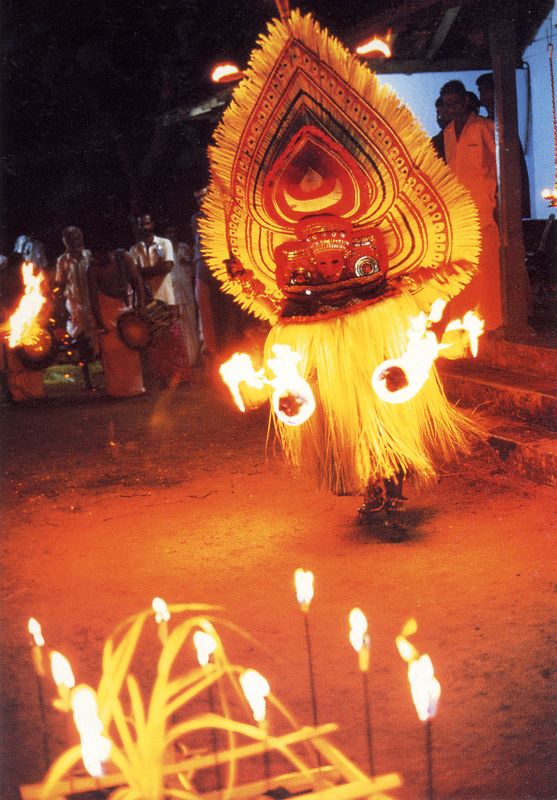 Theyyam Performance:
The performance is always preceded by preliminary rituals. Certain deities are initially honored with the tottam, or song ritual, when the artist, wearing a simple costume and with minimal makeup, sings the song that relates not only to the deity's myth, but also to the origins of his or her relationship with the particular shrine. For the more active warrior gods, a vellattam, or energetic ritual dance incorporating martial arts, is required. After this the performer will retire to a temporary structure to be made up and costumed as the actual Theyyam. When the moment comes, he will enter the shrine to complete the ancient and complex process that has already begun edging him out into an extraordinary otherness. The most sacred and powerful element of the costume, the mudi or headdress, is put on once the artist has been seated on a sacred stool in front of the sanctum. After this comes the actual moment of "becoming" the deity, the moment of crossing the line, as he stares into a small hand-held mirror. It is at this point that, almost imperceptibly, he slips into another state of being, his eyes widening as they focus not on his own reflection, but on the enigmatic features of a divine being. This is the moment of fusion, the defining moment known as mukhadarshanam, or the seeing of the face. It is the moment when a mortal becomes a god.
|
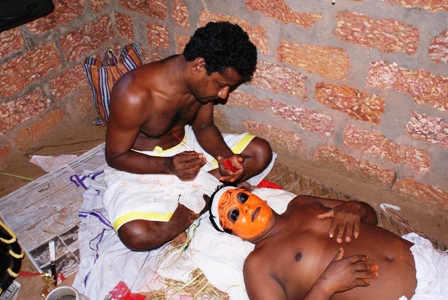 Theyyam Performers: Theyyam’ performers belong to one of the Hindu communities (Malayan, Vannan, Velan (Thuzhuvelan), Koppalan, Mavilan, Chingatthan, Panan, Parayan, Pampatharavan, anhuttan, Munnuttan etc.). Each individual caste has the right to perform certain deities and all performers must poses a wide range of extraordinary skills. They must know the ritual and character of every deity. They have the inherited right to perform, know-how to sing, dance with the drum, do the complicated make-up and dress their costumes. Theyyam artistes are male. It is not a profession or calling that can be adopted. The artist's shrine rights are always inherited from the mother's family and when he marries, he also acquires the shrine rights of his wife's family. The artistes share a common training and tradition in which the process of becoming the deity is achieved after intense mental, physical and spiritual preparation. All Theyyam artistes must be able to do much more than just perform. Every deity's physical appearance conforms to an image envisaged centuries ago in the dream or vision of a respected guru. An artist must know how to make the headdresses and costumes of all the deities, how to apply the face and body makeup in all the different styles and designs, how to sing, play the drums, and know the stories, songs, and character of each deity. |
||
